Problems? See this thread at archive.org.
It should work as long as the EX920 is not an "AHCI only" NVMe drive. The RAID0 acceleration will be limited by the slower of the two drives, and if the capacity is not identical, it will be double the capacity of the smaller drive.
It will still work. It i not recommended for the reasons mentioned above. Otherwise, it is not an issue. Using mismatched drives simply replicates the attributes of the lowest common denominator in the RAID membership.
-
-
New AS SSD Benchmark/CrystalDiskMark record achieved with the new IRST 16.8.0.1000:
![[IMG]](images/storyImages/kzhTgL7.jpg)
![[IMG]](images/storyImages/HVhrrVy.jpg) Vistar Shook, ssj92, jclausius and 2 others like this.
Vistar Shook, ssj92, jclausius and 2 others like this. -
m.2 905p optane damn runs as hot as 961 requires a heatsink
Vistar Shook and Vasudev like this. -
Reinstalled everything and went with 64Kb stripe size & Windows 7:
![[IMG]](images/storyImages/7V7UYZY.jpg)
-
heh the best sata SSD would be the Fujitsu SLC with sandforce controller. hitting around 50 MB/s with 4k random read. those are rare as hell though i was only able to buy 1Vasudev likes this.
-
The first thing I did when I got my MSI machine was to deconfigure RAID, I don't like the idea of decreased reliability. For very marginal gains or none at all.
Vasudev likes this. -
So the new m.2 from Newegg finally arrived after getting lost in transit once. I put it in and followed the above in BIOS. Made macrium image before starting the conversion process. How will I know when the process is complete? After I configured it in BIOS, pressed 'create', it immediately lists the volume as 'normal' and 'bootable'. Shouldn't it take a while though? I'm leaving it overnight for now. Or am I supposed to do this first, exit BIOS Saving changes , and then the process begins?
-
-
When you create a RAID membership in the BIOS is it instant. The RAID volume is empty, unallocated disk space. There is no conversion time involved. You can restore your Macrium image with data to that blank RAID volume.
The conversion noted above is when you create the RAID membership within Windows without losing any data on the primary drive in the membership. If you were creating it in Windows on blank disks and not saving data that would also be instant conversion. A reboot before formatting the new RAID volume or attempting to restore an image to it is in order. -
Yes but you mentioned here that it will take a while to convert my windows volume to Raid0. What were you referring to?Mr. Fox likes this.
-
See my edit above. I quoted my original post for context.
If you add a Windows volume to a RAID0 membership in the BIOS it will destroy the OS (or data on a non-OS volume) There will be no conversion. You will have to reinstall. You can probably restore a Macrium image of the OS to the new RAID0 volume, but you will need to boot into Safe Mode the first time to allow Windows to reconfigure itself to avoid a BSOD. This only works for Windows 8.X and Windows 10. Windows 7 would have to be reinstalled from scratch because booting into Safe Mode will not reconfigure the volume for RAID. With Windows 7 you would need to do a registry tweak to allow RAID before creating the image. Once the image is created it is too late to correct it.Papusan likes this. -
Okay so I pressed save and exit earlier and now it cannot boot. Is there a better way to fix this besides restoring the image?
-
Probably not. What OS? Windows 10?
You can try breaking the RAID membership in the BIOS to find out of the OS was destroyed, but my guess is it will be toast. But, try it anyway. You might get lucky.
Restoring the image shouldn't be too difficult. If it won't boot, restore the image. Change the BIOS to RAID and boot into Safe Mode, then reboot normally and use RST to create the volume and convert it in Windows. (This will require the conversion time.) Or, create the RAID membership in the BIOS and see if you can restore the image to the RAID volume using Macrium Reflect. If it allows you to, boot into Safe Mode the first time to allow Windows 10 to reset itself for RAID.Papusan likes this. -
Okay so basically first try bios> irst>os raid volume >delete right?
-
Yes. It probably will not work, but there is a chance it will if it did not corrupt or erase the drive content.
-
Tried it and it still wont boot. I'll try making the raid array in bios, and then restoring the macrium image to it.
So for future reference, about the steps you initially provided me, which part did I leave out? I don't quite understand yet.Mr. Fox likes this. -
The original post you quoted required having the BIOS set to RAID versus AHCI, booting Windows 10 into Safe Mode to let it reconfigure itself, then booting into Windows normally and using Intel RST to create and convert two or more drives into a RAID membership. (For Windows 7 you would do a registry tweak first before changing the BIOS from AHCI to RAID.) When you create the RAID membership in Windows using RST you select which drive to preserve the data from. The added drive(s) are combined with the membership and any data on the added drives is lost. Can can copy any files you do not want to lose over to the host drive you are preserving before creating the membership.
Where the process went south was creating the drive membership in the BIOS. The only step that needed to happen in the BIOS was changing AHCI to RAID. Creating the drive membership in the BIOS is what destroyed the data.Papusan likes this. -
My bios was already in raid so all i needed was the windows step right?Mr. Fox likes this.
-
Yes, that would be correct.
-
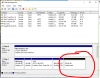
The raid and restore was successful. One little problem - when I restored the image I forgot to expand the restored C: partition within macrium, so it looks like this:
I cannot extend volume from disk management (extend is greyed out). I know one way is to restore again (but with partition resize), or is there a bootable disk tool I should use to utilize the unallocated space? I also have minitool partition wizard, but I don't know if extending the volume from within Windows is safe or not. ThanksAttached Files:
-
-
I have a question, I mounted a RAID 0 with 5 SSD (Samsung QVO 860 - 2TB), thinking it would have a performance of 2000/2500 .. It happens that is no more than 1600/1700. What would be the reason? Use on a MAC and SOFTRaid in Raid 0.
Thanks -
yep worse performance. raid increases latency mean reduced 4k read/write performance. the only benefit you'll get from it is sequential read/write but if your device caps out at 500MB/s no need to stripe raid 0 two 500MB/s device together as you lose performance.
whats your computer? if its pre skylake CPU then they are dmi 2.0 so that speed is what you're seeing pcie 2.0 x4 ~DMI 2.0.Vasudev, tilleroftheearth and Papusan like this.
RAID 0 SSDs - worse performance?
Discussion in 'Hardware Components and Aftermarket Upgrades' started by Lightning_-, Dec 1, 2018.