 Problems? See this thread at archive.org.
I use balanced setting always i.e 128 and in battery mode 200.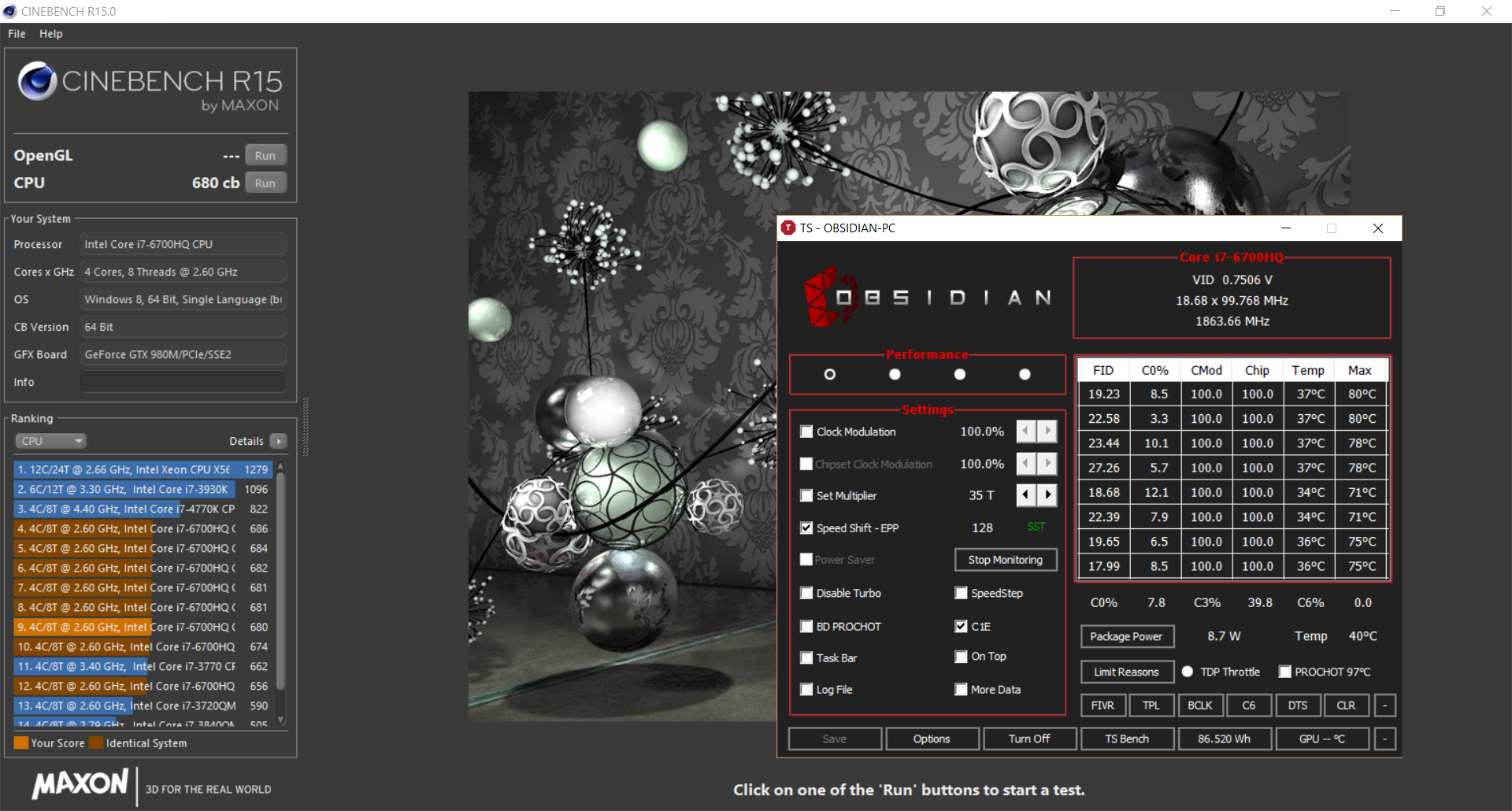
-
-
128 never reaches max turbo speeds. You have to go 102 to start hitting max turbo on my skylake.
Sent from my iPhone using Tapatalk -
-
By the way, I always use EPP 0 or High Performance windows profile.
Sent from my iPhone using Tapatalkhmscott likes this. -
-
It does seem to have an effect with Skylake with 1 point higher than 128.hmscott likes this.
-
Did you click on TPL and enable both Speedshift and next option. Disable Intel Power balance, TDP control and untick clamp option if present.
-
-
-
That's interesting, I wonder if there is a power tune / voltage tune automatically happening with TS vs XTU that holds the defaults unless you change it yourself.
Have you noticed this @unclewebb ? Is there an explanation?
Try exiting the XTU Systray app, as it has a monitoring tool that draws CPU as well. After booting I exit the XTU Systray app unless I am going to do tuning.Last edited: Jul 17, 2017 -
I always wondered, how does xtu save the undervolt values even after a reboot on locked HQ chips.
Sent from my iPhone using Tapatalk -
XTUservice in services.msc does this.
-
Have you used XTU's interface yet for undervolting?
You set a value, Apply the value, then Save a Named Profile with the tuning. That way you can have several profiles and select between them.
XTU loads the last selected profile at each boot and applies it for you.
If you crash, XTU will notice this and it will not load the profile at next boot - just in case it was a setting in that profile that caused the instability.
XTU doesn't know if that's true, but it makes sure that you don't get stuck in a boot / crash loop
Even an unrelated crash will be noticed by XTU at next boot it won't load a profile.
You just need to go into XTU, select a profile, Apply it, and XTU will load that Profile at the next boot - and keep doing that until you crash. Vasudev likes this.
 -
Yes I have tried it once but changed to TS after noticing XTU modified even the default profile with my undervolt settings.
Sent from my iPhone using Tapatalk -
That's not possible
The default profile can't save changes, that's the whole point of the default profile.
You need to not only select the Default Profile, you need to Apply it before the profile settings are... applied
Otherwise the current settings will continue to persist, until you Apply new ones, either set manually or loaded from a Profile.Vasudev likes this. -
It is a known bug reporter by several people. I opened XTU and the default profile had my undervolt values. Since then I never installed XtU.
Sent from my iPhone using Tapatalk -
Just as a quick reference I saw my highest CinebenchR15 score (1048) with microcode BA installed on my 6700K system, and CPU scores in 3DMark bechmarks are all the same both prior to installing latest microcode and with latest microcode - so I don't think latest microcode decreases performance.
-
I always save the default clocks and settings by giving a new profile and save it.hmscott likes this.
-
Don't give up so easily, we've all been using XTU for many years, and occasionally a bug is introduced in a new version that we want to avoid, so we run the previous version without the bug - it's that simple.
I'd try creating my own "default" profile - obviously with a different name - and use that to load safe settings for doing work.
After you find stable settings for undervolt and multipliers (if you have such a CPU) you won't need to rely on "default" any longer.
Exactly, don't let the software get in your way, work around bugs
-
Nice seeing people take a look on TS. You can play with 4 OC profiles. Put safe voltage settings for your oc. Then try different voltage settings in your testing without put a fixed all too low voltage. A easier way finding what fits your chips.
See post above. Xtu is more for those who like a fancy not useful colorful graphs. But forget it will eat more processor cycles vs. TS.
Although this Xtu functionality/features, I have run into bootloops or even no boot with XTU running before on my AW17. I wouldn't trust it too much. And the 2013 models from Alienware was a pain in the ass fixing Nvram reset. A screwed design aka where Cmos battery was placed and how the reset functionality worked. Almost impossible to fix it. Especially with the 120Hz models. Maybe better reset functionality now for newer laptop models. But some models need a fully teardown for resetting Nvram. People who can't or don't dare opening their machines will have a nice time when No post - bootloop will be the end results of their tuning. -
Yeah, that's too bad, I know AW wasn't having a good year with their screen's getting EDID(?) messed up from various sources.
XTU didn't kill any screens, but had been long term using / overwriting / clearing an area of the BIOS reserved for use that AW was taking over - pretty sure it was their mistake. I think XTU fixed that by moving to another region(?).
So far in the almost 7 years I have been using XTU, started with the Xtreme Edition desktop CPU's, I haven't had any bugs that killed my laptop, boot looped, or otherwise was a problem other than backing up to a previous version when XTU messed up a release.
I think the weirdest thing was there was a release of XTU that required installation As Administrator, but it only need it for one release version
Then again, I'm not on Windows 10, all the Windows 7/8.1 bugs are long resolved, same for everything else, just Smooooth sailing all day long
Last edited: Jul 17, 2017Papusan likes this. -
You talk about the Voltage spiked(higher than normal?)... Aka same with the old microcode? Have other seen the same?
-
1.1v on full load i.e 31x on 4 cores. Now it is using 0.95v. Dunno what caused it.Papusan likes this.
-
Voltage varies with the type of 100% load applied the CPU, for instance the latest version of Prime95 will kick the CPU up to it's highest voltage, whereas if you have your CPU at 100% load using other programs the voltage often doesn't climb as high - this is on desktop, so I guess the same as mobile. (Vcore as seen in HWInfo). So you'd have to compare the same type of load to draw conclusions on voltage.Papusan likes this.
-
Same load. 0.95v with the old microcode. And 1.1v with the new?
Always save old data from your previous tests. Compare with same types clocks, settings, load and software. Or you will get wrong answers.Vasudev, Robbo99999 and tilleroftheearth like this. -
I will save some data from now on. One thing I noticed is that the ucode update isn't permanent, it simply gets loaded during OS startup. I booted up winPE and looked at revision code it was still at 9E instead of fixed ucode BA.
-
Yup, it's a transient overlay at post time with the BIOS loaded ucode, and OS level it happens sometime during Windows startup.
Linux should do it during the initial kernel loading - very early on - much earlier than Windows.Vasudev likes this. -
Damn, did anyone notice this odd clock frequency bug. I'm scratching my head right now. I need more testing to do, eventually if I don't notice this bug on older ucode then maybe I need to take down the ucode link and the guide needs to be edited.
-
I looked at this for a couple of minutes, what am I looking for?
-
Look at CPU frequency in HWinfo, CPUz and TS. All three reporting different cpu core clock frequency. TS is dead precise here. Maybe HPET and TSC timers are conflicting each other.
Temporarily switched to older microcode 9E. Cinebench scores are back to normal.
-
It's really not unusual that different software report CPU clock differently, it happens all the time and I see it on my own PC regardless of which microcode version I have; Throttlestop is generally thought to be the most accurate representation of what is happening to the CPU in comparison to other programs. Really nothing to do with your microcode - completely normal. (No decrease in CPU performance for me with latest microcode).
-
Decrease Polling Frequency in Hwinfo64 settings, then compare with TS. Both are accurate. Hwinfo is set up default (2000ms) with too slow refresh of sensor info.
-
HWiNFO has some delay which I hate using it in a daily basis.
-
Performance improvements and 2C cooler CPU after uCode update. The update works best if done through Safe Mode w/ Networking.
On HT bug uCode 9E: Windows Balanced Power Saver Without undervolt
After uCode updating fixing HT bug: Windows High Performance Power Plan with undervolt -120mV.
Beemo likes this. -
-
Stopping monitoring inside Intel XTU reduces my temp even more:
(idle temp)
![[IMG]](images/storyImages/nw0LDuK.png)
Unlike before...I set clock speed to lowest as possible and undervolted to -0.080V...
(idle temp) but still hot as hell!
![[IMG]](images/storyImages/ZoSuwVk.png)
I'm now a happy man achieving this temp with my laptop.Last edited: Jul 18, 2017hmscott likes this. -
@hmscott @Midas Touch @Papusan @THEBOSS619 :
An update: I installed the latest uCOde on my older Pentium 2020m and somewhat newer Broadwell 5200U there was noticeable performance boost. So everyone can apply newer uCode regardless of PC's age.6.|THE|1|BOSS|.9, Beemo, Papusan and 1 other person like this. -
Yes, I think they should update to the latest uCode...there's no harm in doing so.hmscott likes this.
-
Is there a reason it work best through Safe Mode w/ Networking? Why?Vasudev likes this.
-
Yeah, I wanna know this too.
-
Creator's update may be the cause.
-
You have to run it twice otherwise to get it applied.
-
-
I haven't implemented anything. I just included the latest uCode update released by Intel https://downloadcenter.intel.com/download/26925/Linux-Processor-Microcode-Data-File
-
-
-
-
For me, patching through safe mode worked correctly. Depends on AV too. I'm WD(RTP),MBAM(ODS), ZAM(ODS) along with KRD, Dr. Web Cureit.[LiveCDs]hmscott likes this.
-
Thanks, bruh
I can't see the big difference. All is within errors.
hmscott likes this.
Skylake / Kaby Lake Hyper-threading bug
Discussion in 'Hardware Components and Aftermarket Upgrades' started by Assembler, Jun 26, 2017.


![[IMG]](images/storyImages/jtRPuS1.png)
![[IMG]](images/storyImages/ItBUfb2.png)
![[IMG]](images/storyImages/014Y2hu.png)
![[IMG]](images/storyImages/7ZxxwPV.png)
![[IMG]](images/storyImages/2YMHK6W.png)


![[IMG]](images/storyImages/qpGEbbp.png)
![[IMG]](images/storyImages/ja7NV79.png)