Problems? See this thread at archive.org.
i5 520 | 160 GB SSD | 4 GB (1 DIMM) | Default Windows Installation
Maximum Brightness | HP Recommended Power Profile | Wifi On | Bluetooth On for a while then Off | Web Surfing, Listening to Music : 3 hours 13 minutes
-
I realize this varies based on lighting and whatnot, but just what does this magical "radiance display" look like at medium-low brightness?
-
at as low as it'll go it's 'bout the same as 30ish% on any other laptop.
-
Anyone know how much more battery life one would get leaving it on the highest brightness as opposed to the lowest? An estimate would be nice.
-
Well the one guy had everything off and got 7 hours. I saw one guy that had everything off except wifi, and had LCD brightness at 100% and got around 4 hours. So wifi+100% vs no wifi+0% = 3 hours battery life
-
I got about 4 hours at full brightness, wifi on, browsing the interweb (nothing flash heavy, that kills battery life since well..it's adobe flash)
-
Not to be a buzz kill here but.....
Unless intel changed the whole i3/i5 power management design in the last 2 months (which they didn't) then all the talk of setting the CPU % in power plan settings and trying to load only 1 or 2 cores or disabling turbo boost MAKES ABSOLUTLEY NO DIFFERENCE IN BATTERY LIFE. This has been thourougly tested, benchmarked and confirmed by numerous test methods. Essentially the intel chipset driver overides any of the above mentioned settings and uses the intel 'speedstep' technology that was desigened into the cips from the start. In other words Intel trumps Microsoft when it comes to power management of it's CPU's.
To clarify about disabling turbo boost, it has tested out that on average usage that turbo boost uses equal or lesser amounts of power because it gets the task done faster than without it.... And disabling cores has the same general effect, 2 threads take twice as long as 4, and when you disable cores they do not actually shut down, they still use the same power that they idle at and the other 2 take twice as long (or more) to finish the tasks at hand. If your multitasking, disabling cores is actually less power efficient. -
Not to be a Buzz Kill here but, can you link proof?
-
isn't this only applicable if you are using 100% of your CPU? if you are only <10%, it makes sense to disable turbo boost or disable cores if it results in battery life savings -
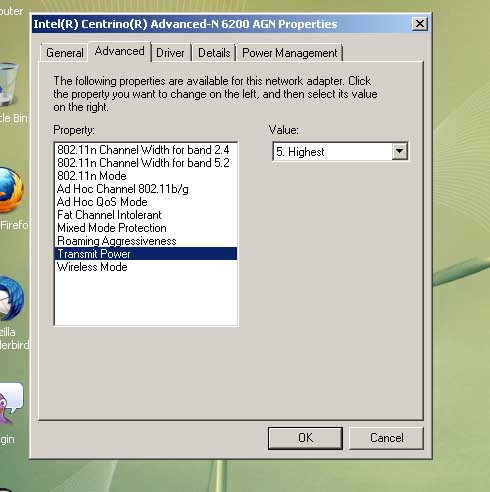
There is no default check box on mine. Here's what it looks like for me:
Attached Files:
-
-
Anandtech did a full comparison also notebookcheck I believe. The envy fifteen gen 1 and gen 2 threads unfortunately are as big as the E 14, there are literally 100's of posts where evry concievable variation on the CPU's have been tried all with the same end result, no improvement in battery life!
If it was that simple then intel or MS would have the best settings in the power saver power plan settings, they are much smarter than we are....
See above and again even disabled they use the same amount of power as if they were not disabled but just idle while the 1st core is used. and turbo boost finishs and returns to idle s fatser than without it so there is no power savings, see anandtech testing article IIRC 'i3/i5/i7 arrandale'
And both of you should read intels info about speed stepping technology.... -
FWIW, I concur with what JJB has stated. No one link will describe this, but some research will confirm what he's said.
I mean, how can you argue with someone that has a bald eagle as their avatar...![[IMG]](images/storyImages/notworthyp.gif)
-
Standard Battery
High Performance Mode
Integrated GPU
60% brightness
Usage: Web browsing, some non intensive fallout 3 modding.
3.25 hours
see sig for specs -
i5-450
160gb SSD
Standard Battery
Integrated Graphics On
"Power Saver" power plan
~30% brightness
Bluetooth off
Wireless on
Web surfing for the last hour and a half (trying to catch up and read the last 1000 posts of the envy 14 owner thread )
)
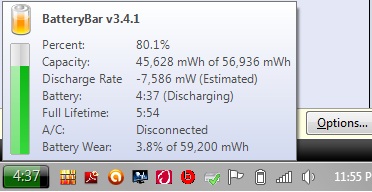
Batterybar is estimating almost 5:54, almost 6 hours!Attached Files:
-
-
Batterybar isnt all that accurate first run through so don't expect to actually get 5:54 hours.
-
+1 you need to do a full run test to be sure. This estimation seems too optimistic
-
This is my second battery cycle. I expect it get more accurate as I do more cycles, but so far it has been tracking pretty accurately. I.e. I had surfed the web for an hour and a half before taking that screenshot and it shows pretty close to an hour and a half difference between the total and remaining time. I'd check every so often and it's been pretty consistent.
On the first power cycle, I got 4:30 doing more cpu intensive stuff, like installing SW, copying files, testing, etc.
I'll post again after a few more cycles. -
Kay so anyone wanna run a power saving mode 60% brightness non flash heavy browsing with the wifi device manager setting I posted set on LOW (maximum battery)?
Also I'll argue with JBB because on any article regarding turbo boost and battery life you can read :
There is a mistunderstanding there, turbo boost does lenghten battery life, not by making tasks done faster, but simply by allowing the use of LM and UM processors with lower TDP while still keeping a performance peak around 2.5ghz thanks to turbo boost. That LM for example will indeed hit 2.5ghz on turbo while keeping a 25w TPD.
The truth is, and I'm saying it ever since I saw UL30JT users complain (and they are running the UM models) about how they were losing battery life if they had intel turbo boost enabled. You can check their thread if you want, or check that article.
http://labs.v3.co.uk/2010/04/intel-turbo-boo.html
What is true on the other hand is that you do gain battery life while keeping similar performances by using a turbo boosted LM or UM processor compared to a not turbo boosted 370m for example.
This article perfectly explains when turbo boost becomes a battery killer instead of a battery saver : DVD watching, video watching, website browsing with flash banners, or any task which has a constant time of completition.
Maybe if you want to encore a video while on battery (which is already an absurd or rare event) turbo boost will get the task done faster and save you some idle time. But...
If you are browsing a website with a flash banner for 30 minutes, turbo boost or not that's 30 minutes you'll spend there with the cores overclocked by turbo boost, wasting energy.
Same goes for dvd or movie watching on battery (those are realistic and common scenarios) your movie is 2 hours long, that'll be two hours of turbo boosting that'll just waste energy, while the dvd couldve been played at stock clocks flawlessly with lesser power consumption. -
Where's the guy who popped a 620LM into his E14? Let's badger him into doing some tests!
-
This was always my train of thought on it too. I can see turbo boost helping battery life if your doing a task that will ultimately stop sooner with more processing power. But if what your doing never ends, regardless of clock speed, then all you do is lose battery life.
-
I'm stopping the turbo boost argument here. Easy thing to figure out by real world use examples and experimentation.
Any further posts on the subject will be deleted without mercy. And with a huge blunt instrument to boot. -
I'm using battery bar too and I was wondering if there was any simulator of "normal usage" (or different types of usages: web browsing, video, combination of them) without me having to physically be here for hours at a time ?
Thanks!
I would love to post my battery log. -
Anand has a few scripts he runs for laptop reviews on his website ( www.anandtech.com), I've emailed him about getting a copy of them and am waiting to hear back, I think if a few other people also poked him about it we could get it faster. His email is [email protected].
-
However you use the notebook between charges is matters most. That includes suspend/hibernate between charge sessions. As long as you didn't plug in for charging before running the batt down.
The idea is real world use. Just note what you did. -
I can't see getting 7 hours out of the default battery.
I left the computer running completely idle with the "Power saver" power plan, 0% screen brightness, blank screensaver, WiFi and Bluetooth disabled, and got a solid 3 hours until the battery reached 29%. I didn't want to drain the battery completely so I'm estimating a bit over 4 hours if I had continued running the computer off the battery.
Is there some setting I'm missing? -
People are getting over 4.5 hours with wifi on. I can't see how you're getting so little with it off.
-
Any possibility that your 5650 is running? I got over three hours on high performance while web browsing using the integrated graphics.
-
I have:
i7 720
8gb ram
160 ssd
factory install of windows(have not yet done a clean install)
i got just under 2hrs on hp rec power mode
am currently trying on lowest brightness and power saver mode but doesn't seem like it'll be much more than 2 hours, if that....
i do have bluetooth off but using laptop for music and web surfing (very minor program installs, etc). not sure why it others seem to be getting 3hrs, maybe its the wifi? -
well. someone managed about 7 hours with the wifi off so *shrugs* I think the wifi's draining a decent amount
-
i5-520m
160GB SSD
8GB RAM
Standard Battery
Clean install, WiFi on (connected to my N router), bluetooth off, screen brightness fairly low, 40%ish?
I took the balanced power settings and tweaked most of the settings to be on maximum savings, and the critical action to be hibernate at 2%.
This was mostly an idle test for my own interest, I develop in Linux primarily and wanted to see what running Linux in VMware Workstation would do to my battery life. So this test is completely idle with VMware workstation full screen running Ubuntu 9.10.
Result? 6:27. -
wow thats pretty good....i think i'm going to downgrade to the i5 from the i7....after reading everyone's experiences, i think it will double avg battery life from 2hrs to 4hrs
-
Wow, that's awsome. I have a feeling the key to great battery life is going to end up being:
1. keep screen brightness below 50%
2. a fresh install
3. tweaking those power profile options for maximum battery life
On your typical notebook, most people usually set brightness to between 50-80% anyhow, and see'ing how this screen is naturally brighter by nature, you could probably get the same brightness level as other notebooks at 40-70%. -
Has anyone noticed a benefit from using granola? I just installed it, and I'm not entirely sure what changes it makes in order to get its energy savings.
-
Could someone please share some extreme battery saving tweaks/settings? THANKS SO MUCH!
Anyone tried Granola yet for battery life extension? -
So on my i7 (i posted a few posts ago) - on power saver mode and lowest brightness setting, I got 2 hours even (5% battery left) while playing music and surfing the web.
-
If you have time can you do an idle run down like I did so we can see what the base line system power draw is? You should probably also consider a clean install, and verify in CCC that any relevant power saving settings are enabled. I would expect you to get over 3h at least on idle.
-
From 1.5 to 3.25 hrs since Friday.
-
In theory granola sounds like a great program
How Granola Works -
It looks to me like they are doing exactly what our CPUs do automatically when on battery with the appropriate settings anyway.
-
That's pretty sweet. A couple questions: did you tweak the wifi's power profile so it expends less energy, or was it standard? Also, how far were you from the router? As cell phones burn a lot more battery in low-coverage zones, I suspect that a stronger (i.e. closer) wifi connection will decrease battery usage, since it won't need to stretch as much to get a usable signal.
According to a comment a week or so ago by JJB, the power draw from the E14's screen shouldn't change significantly as you lower the brightness level - it might be significant enough for half an hour on a full charge if you go from 100% to 0% (I don't recall the numbers exactly), but it's not nearly as big a difference as it is on older laptops like my Inspiron 1420.
Agreed - isn't this basically what SpeedStep does? Maybe its advantage is that it works with older computers that don't have that kind of capability built in, but I don't see something like this having much value into the future, since this kind of technology is pretty much built-in these days.
Actually, having been out of the desktop realm for quite some time, do desktops self-throttle in low-load situations, or would granola be beneficial for "greening" a desktop? -
I set the wifi adapter to be on maximum power savings in windows' power profile, and the router was probably 15-20 feet away through a cabinet and a wall.
This is also my guess of their value add.. they do mention servers which are in a similar situation, but with virtualization beginning to dominate datacenters it seems to be a moot point there. -
I ran the same test with discrete graphics on in maximum power savings mode to determine the difference:
4:35 run time
So just doing some math, 12.87w - 9.15w = 3.72w increase in power draw for discrete over integrated graphics. Does anyone know if integrated graphics is powered off on this laptop when discrete is turned on? -
Has anyone tested battery life with that setting set to lowest ?
Someone confirmed that even if you put windows in maximum power saving plan it does not set this wifi card setting to lowest (maxmim savings, wifi will be slower but will eat much less battery).
Thanks -
I don't think wi-fi will be slower, it just will have less range, so if you're close to the router or access point you might be able to get away with it.
-
sure i can try that later tonight or over the weekend...creating recovery disks to do a clean install now and will do that first...does anyone know if i can re-install hp quickweb (or another instant on solution) after doing a clean install?
-
sure i can try that later tonight or over the weekend...creating recovery disks to do a clean install now and will do that first...does anyone know if i can re-install hp quickweb (or another instant on solution) after doing a clean install?
-
I powered up the notebook (unplugged after a 3 hour charge) and got exactly 4 hours from a stock ENvy 14 before it died at 2%. I did nothing during this time on the notebook, as requested by someone, for this test. I made the following adjustments prior to the test.
- I changed Power Plan to "Power Saver" and tweaked the following
* Display set to 80% brightness because I could not see anything on the screen below that setting due to flourecenst lighting in the room and glare
* Disabled Sleep and Suspend modes
* Disabled Screen Saver
* Disabled Display Dimming and turning Off
* Enabled Always On for HDD
Wireless was disabled but the notbook was connected to an active Ethernet network.
Again, I would never use a notebook like this and just becuase I can say that my notebook gets 4 hours of battery is just silly. I live in the real world and with a stock system and 7 days use, "normal" is between 1:30 and 3:15. I had time to kill and didn't need to use the E14 during that time so I tried this. My new one was ordered exactly like this one knowing the battery life and price for performance when I need it. If I need 3 to 6 hours then I'll get a slice if they come down in price. -
Thanks for that. Would anyone with an i5 CPU be willing to try something similar in terms of a constant brightness and disabled sleep settings?
-
Uh scroll up thats what I did ;p My brightness was lower however.
-
According to both batterybar and CPUID temp monitors, my battery wear level is at 13%. it was 3% this morning after I turned off my computer after several hours. Is is false reporting? or did my battery actually lose that much capacity?
Envy 14 Battery Life Log
Discussion in 'HP' started by 2.0, Jul 18, 2010.