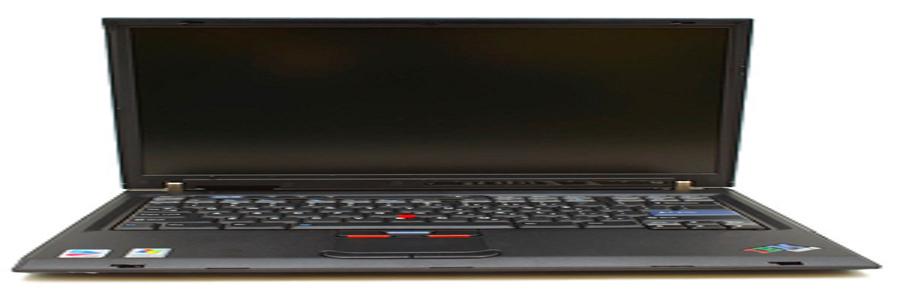
Problems? See this thread at archive.org.
I think it's a market ploy to sell people smaller screens. What next? A 12" screen that is 12 by 1?
-
I believe nearly everyone in here will answer positive to your question. And for the record, I think they may push out 12 by 1 with the brand "the Think Foot-long"
-
I do not hate that the aspect ratio is getting narrower, I like the widescreen. However if the screen become any more narrower, I will hate it. I think 16:9 is here to stay.
-
I don't get how that is a marketing ploy. Are you saying that they are going to make more money if they produce 16:9 instead of 16:10? If anything I would call it a trend.
-
Give me a good screen, which is tough to get these days, and I'm a happy camper. I think in the 12" market widescreen actually works better, at least for me. On a 12" XGA isn't wide enough to use a FF and the sidebar, which is why I never got a X60, but the WXGA is just about perfect. Now if you talking a 14", then I'd take SXGA+ because the 1050 vertical resolution is more useful for things like Office and Internet. If anyone ever makes a 14" SXGA+ notebook with an IPS screen, they've got a customer for life in me.
-
Not to mention that the 12" widescreen allows space for a full-sized keyboard as on the x200 and x201, where the previous x series ThinkPads had to shrink some of the outer keys.
-
ZaZ you are hard customer to keep... 14 inch IPS SXGA+... laptop companies have to invest oodles of money to just keep you.......
-
I think I'm worth it. Lenovo should be giving a laptop anyway.
The X6x keyboards were excellent even if some the keys were a bit undersized. -
It is fueled by cheaper production costs and the HD resolutions. But unfortunately as you keep getting wider it is less prone to productive office work. Media has it's place but unfortunately OEMs are generally at the whim of panel producers. I at least like that Apple is pushing IPS. I wouldn't mind seeing IPS popup on more mobile devices
 .
.
-
The Zaz Edition is long overdue...
-
use windows "window key + left or right arrow" function on a big 16:9 monitor and effective you'll get two monitors with 8:9 ratio.
-
Yes, side by side documents is helpful. However, losing vertical resolution cannot exactly be made up for.
-
17" 16:9 screen has less area than 17" 16:10 screen (which itself has less area than 17" 4:3).
Less area = higher yield, cheaper production. While you can still market it "17" " and people will think "it's same size", while it in fact, not.
I learned to hate 16:9. I had to place taskbar vertically (which is not very efficient by itself) just to make some use of this useless horizontal screen estate. So glad I am back on 16:10 now, in any case 1920x1200 is a lot more useful than 1920x1080...
Marketing trying to justify it as "better suited for movies". Sure, no arguments here. But who buys laptop primarily just for watching movies? -
im actually returning my hp dm4 to get a t400 because of this reason. if the dm4 was matted/16:10, I would keep it easily.
-
unlikely for a consumer line of laptops.
-
Because they can call a screen with less area 12 inch. For example a 12 by 1 screen is still 12 inches.
-
screen size is measured diagonally. So that size you mentioned is not going to measure 12.1 inch diagonally.
-
Well it is 12.041594 inch diagonally.
-
something like that... and that could happen, since those digital typewriters had an one or two line display for a long time....
Figuratively speaking, the space for keyboard would also decrease to a one or two liner if the LCD was that small. So i guess everyone can type up a thesis or word document like a piano player. -
I understand. I thought you meant they "invented" wider screens just to make more money. While deceiving to some, most computer literate people know what they are getting when they buy it.
-
They didn't invent them.
But they surely though that adopting "wider" 16:9 "movie" format is the great idea - because it will basically justify reducing the screen area (while still putting the same "inch" number into "specs for dummies" sheet). That's why all hardware manufacturers gladly jumped in queue of 16:9 adopters - who doesn't want to save costs? -
this is a futile argument, would you guy for a square shaped monitor? 1:1 would give you the largest amount of area. (for a quadrilateral).
what about other shapes, may a rhombus? kite? trapezoid?
wait how about a circle? a circle of a diameter of the same length would give more area than any quadrilaterals.
somebody make a circular monitor. -
I so want to see that in action. I probably could get 1-2 words per minute from a piano style keyboard
Also there already is a "laptop" with a screen wider than 16:9: the Sony Vaio P (not a laptop but still is a computing device. Since it's 1600*768, better prepare for 16:7.68 aspect ratios
-
Personally, I would like to see laptops become little boxes with no buttons or screens. The box would simply project a panel of suspended light sources (floating pixels) that hang mid-air in a matrix of force fields. You would be able to physically grab the fields around the light and stretch the display to whatever aspect suits you. The keyboard would also be a force field panel of suspended light sources which have adjustable textures, pressures, and luminescence. But the keyboard would only be a last resort, to be used if for some reason the computer couldn't understand what you were thinking.
-
There are companies that is starting to make 21:9 hdtv. Shutter to think of what laptop like that would look like.
-
Something like this...
Attached Files:
-
-
that is the PianoPad.
-
I picked up a T500 last December mainly becuase I did not want the wide screen that was announced for the T510.
-
I wouldn't, because of aesthetics of it.
This is pretty interesting - Golden ratio
Majority of paper page sizing nowadays made with this in mind. And 16:10 screen seem to be the closest. -
However, if you look at how information is presented in those papers you notice that it is in narrow and long columns. From a cognitive perspective vertical scrolling is bad i.e. loss in vertical pixels is bad for most productivity oriented tasks.
-
unless the LCD companies have some interest in the cognitive learning of its customers, then they probably wouldn't care either way. Long term profit for them is more important than anything else.
-
I can see the marketing for the 12"x1" screens now. "Increase your productivity - open 12 windows side-by-side for easy document editing!"
I would have gladly paid $200-300 extra for a 4:3 laptop. I made do with my old T43 for 5 years simply because of the shortened screens of the new models. Unfortunately I was forced to purchase another brand last week because the 15.6" Thinkpad screens were too small and I wasn't willing to pay $2500 for a 17" W series. I miss my Trackpoint!
One of the manufacturers is going to eventually shift back to the taller screens and have a flood of customers on their hands. -
it would cost Lenovo more than 200 to 300 dollars to maintain a steady supply of 4:3 LCD from the LCD manufacturers, while simultaneously producing several laptop models that compete against itself in the market.
You can get a T61 in the 14.1 inch 4:3 LCD format, and when you update the CPU to the T9xxx, it would give a T400 a run for their money.
Just curious which brand did you end up buying for your taller LCD?
P.S. Well a manufacturers could shift to the 4:3 format, but they will charge something north of 2000 dollars. Would you be interested in these sort of machine? -
My t61p is 15". I wouldn't have anything else.
Renee -
so you got a 15 inch T60p and slotted in a T61p motherboard?
-
I purchased a Sony Vaio F12. It's not an ideal solution but it does have a larger 16.4" screen while still being small enough to work as a true laptop for me. Some of the 17.3 inch behemoths are big enough and run hot enough that there's no way I'd be able to reasonably use them on my lap. The I7 processor in this one runs very cool most of the time.
I did consider purchasing a refurbished Thinkpad but the 15" 4:3 models available were not all that much more modern than to my old T43. I didn't want to end up needing to upgrade again in 18 months.
I'm curious, where do you get your pricing estimates for 4:3 screens? $1000+ extra for that form factor seems extreme. -
16.4 inch and 15.6 inch doesn't seem to make a lot of difference, especially if you only got a 1600 x 900 screen. I am assuming you got the i7 Quad Core or just the dual core model?
Also, Lenovo would have to charge a lot, since the demand for this machine would be limited to a small market segment, which means it Lenovo will probably charge a bundle for this or make it into some special limited edition model.
1000 dollars is just an educated guess, but this is sort of price range that one would expect. -
My take: The retail price of compete 17" monitors, both 4:3 and wide screen, are under $120 putting the wholesale price of both well under $100. The manufacturer's cost for either LCD display is likely under $50. Yes, a 4:3 monitor is more expensive, but only by 10-20% or maybe $5 - $10 per display. Let's say for argument's sake the real cost premium of a 4:3 laptop display is 5 times that and you're still only looking at a increase to the laptop builder of perhaps $25 to $50 per display. That's not likely to be passed on as a $1000 increase unless there is truly a tiny market for this type of machine.
Considering the number of people that find the mail slot approach to the displays of current laptops unacceptable (and every PC user I know does), I don't believe it's a small market. Add that to business users that primarily edit documents and spreadsheets and huge companies that *never* purchase machines for the purpose of viewing movies and I think you have a very, very large untapped market for a 4:3 laptop.
My opinion is when these larger screen machines are produced the cost premium over a mail-slot screen will be 10-20% or about $100-200 on a $1000 machine - and that these machines will sell like hotcakes. -
17 inch desktop monitors? You want to fit a desktop LCD into a laptop? Hum.... also, no company still produce 4:3 LCD for desktop LCD.
The cost of manufacturing depends on how many LCD they manufacture, to produce 1 million panels each year, you may get it for between 50 to 100 dollars. Anything less than that you would have problem to get it for that cheap or convince the large panel manufacturer to divert their resources to produce this product.
Regarding how much Lenovo charges for the privilege of have 4:3 LCD, then it depends on their opportunity costs, amount of risks they take and how much yield they expect from this business venture. If this is feasible, most of the tier one laptop company would have jumped to it, and not have moved to 16:9 LCD instead.
Basically, i think you overtly simplifying the complexity of issues dealing with such venture. -
Newegg currently has 46 desktop monitors with a 4:3 aspect ratio available out of about 300 total. They're still being produced and the parts and technology are nearly identical to laptop displays.
-
Just because Newegg lists them, doesn't mean they are still been produced, they are just left over stocks.
-
Oh, plenty of good 4:3 LCD panels are still being produced, go to any big panel manufacturer product list and see.
The problem is that no laptop models are getting designed to use them. That's entirely laptop manufacturers fault, not screen manufacturers. -
NEC, Dell, Viewsonic and Asus list 4:3 monitors as part of their *current* product line, and I only checked 4 manufacturers. Your information is simply not accurate.
-
Although it may be possible to manufacture 4:3 laptops, I think you overestimate the size of the population of people who prefer them over 16:10 or even 16:9 displays. In fact, the first thing my dad (a long time business Thinkpad user, who uses his laptop exclusively for corporate email, PowerPoints, Excel spreadsheets, and Word docs) said when I got my T500 was "Hmm. I wish my T60 was widescreen."
Since then, many of my friends who have 16:9 laptops have commented on how "tall-looking" my T500 is. No one I've talked to, even the computer programmers I'm friends with, want the 4:3 format back. Some of these people do prefer 16:10 over 16:9, but most either don't care or even prefer 16:9 over 16:10. Anecdotal evidence, but it does give you some idea of how small the minority of people who prefer 4:3 screens is in the general population of computer users, and even in the general population of business users.
Their reasoning? There's much to like about 16:9 or 16:10 displays as well. In smaller laptops, it allows for full-size keyboards. In larger laptops with higher resolution screens, it allows for more flexibility in viewing documents side by side or with a sidebar. When having meetings, larger 16:10 (and even better, 16:9) laptops allow one to easily look over an open laptop and talk to other people, while a large 4:3 laptop's tall screen could actually partially obscure your face.
Personally, I prefer 16:10 over both 16:9 and 4:3, since it allows for greater flexibility in the use of the screen space. With the shift to 16:9 screens in the 15" laptop segment, 1920x1080 is becoming far more prevalent than 1920x1200 ever was before, giving more options for high-res laptops in that size segment. In fact, the 1920x1080 format is even making its way into the 13.3" segment, with the Vaio Z.
So, in a roundabout way of saying it: compared to other potential markets to be tapped (ie: 16:9 widescreen market, even the touchscreen market), the 4:3 screen market is far from being a "very, very large untapped market." Lenovo, and other OEMs, would much rather spend the time and resources they would have to allocate to the designing of a 4:3 chassis for every model on, say, the simpler task of designing touchscreen options for every model instead. From a marketing point of view, it just doesn't make sense. -
Lenovo also insists that IPS screens are the "niche market"
And look at all these people jumping at HP bandwagon now. -
All of the technical users I know despise wide screen laptops and are holding on to their old machines as long as possible. The couple of people that have bought new ones hate the mail-slot effect.
As I sit here having to scroll up and down to see a technical program menu that fit just fine on my 5 year old 15" Thinkpad monitor I can't help thinking you're wrong about demand for the taller screens. Time will tell. -
I'd have to agree with Midnight on this one. While there certainly is a small vocal group who care about this, the preponderant factor when choosing a notebook is cost. Typical users/buyers don't care very much about this. For Lenovo or any other manufacturer to buck the trend and offer 4:3 notebooks would make their notebooks much more expensive and in today's world, where everyone runs to SlickDeals and FatWallet in an effort to wring out every last dollar, completely understandable, it's not a viable option for manufactures to go against the grain.
-
Just quoting for truth really, price is the #1 factor of importance for a majority of buyers and the enterprises that purchase thousands of ThinkPads are demanding lower prices and options from Lenovo, which is not conducive to niche screen sizes. The X100e exists because a large enterprise buyer said they wanted a cheaper ThinkPad option. Though you may read a lot of stuff in forums about wanting niche screen sizes it's the 90-9-1 effect there, people vocal about such things tend to not represent the mainstream.
-
I know for a fact that Dell and Viewsonic stopped producing 4:3 LCD monitors..... if there is any stocks left, it is just left over or refurb stock. NEC maybe still have them, since they stockpile IPS and other high quality panels. ASUS? Maybe you should go and check out the year when the LCD panel is made, these LCD are clearly old stocks.
If you don't believe this just call Dell up, and get to a product manager, then ask them. -
Andy, I noticed you've been slumming it with us rubes the past few days, what gives? I get asked a fair bit about which notebook someone should get. Cost is almost always the question asked. Most people don't know enough to care. After cost, people ask about performance like CPU, memory and hard drive, then what size to get. Occasionally, people do ask about screen quality, but aspect ratio, almost never.
The people here are enthusiasts, much more willing to devote time and effort into their notebook purchase, but they in now way represent the typical buyer. This really skews the perspective because it makes it seems like a larger trend than it really is. I'd say if you got a 4:3 or a FlexView notebook you really like, throw in a SSD and hang onto it. A newer machine, as much as Intel/AMD would like you to think otherwise, won't offer much better performance unless you're pushing it, which typical usage won't do.
Any one else hate the wider and wider screens?
Discussion in 'Lenovo' started by jihe, Aug 5, 2010.