Problems? See this thread at archive.org.
jedi, would you mind benching all these via either CrystalMark or HDTune in one go under the same conditions? Wouldn't mind seeing the benchies on the ExpressCard drive in particular. Thanks in advance.
dave, where did you get 128GB for $200?
-
ebay, as said before..
-
The only reason not to keep mechanical drives for long periods is because the older the drive, the greater it's potential for failure. SSD's should be able avoid that, hopefully ushering a new era of longevity.
Motor/bearing issues from time and stop and starts.
Platters start degrading in an area that will grow with data loss.
Data should be routinely rewritten after long periods of time to refresh the magnetism, there's tools to do that.
If it wasn't for those things I'd keep it for 10 years, why wouldn't I.
My 74GB Raptor is now going on 5 years, but I monitor it to make sure it is still working optimally. I will keep it until it doesn't.
I still have drives that are probably going on 8-10 years, unfortunately they can't be used in any mission critical locations so their usefulness is low because of increased potential of failure, and that is the only reason.
When it comes to an SSD, for an average techie, they should want to keep it as long as they don't feel like throwing money away. It's like throwing out your DVD you burned with pictures on it because it's 5 years old, it's age isn't reason enough. If it's speed or storage is crippled well then It could make sense to upgrade but not necessarily throw away the old SSD due to age alone, unless it has other causes of failure. -
Has anyone heard any hard figures or estimates on how long an SSD can be unplugged from a power source, not run at all, and still retain data integrity?
Could it go 6 months? Is it a matter of months or even years?
I doubt any tests have been done, just wondering if anyone has ever provided any reasonable estimates based on the technology. -
i guess as long as you can let a usb stick lie around not using it. no clue, maybe you find info about that. normally it should never matter at all, no.
-
If SSDs prices will be reduced by putting controller on motherboards, than motherboard prices will go up.
This is not good for users who do not want to use SSDs or users who own SSD and just want to upgrade motherboard. -
flash in general has to have a retention time in the year+ range, at least for the single-level stuff... it's been used in all manner of single-write applications (like a NIC configuration area) where it would be written once then expect to live for a loooong time. also, i dont think the memory values are 'refreshed' when you plug the drive in anyway... you write a cell by pushing a bunch of electrons into it, then that charge remains until you erase/write it again.
not sure if a flash based ssd would be as reliable, as it's certainly more complex than a flash chip on a NIC holding a tiny config file.
grrr wish i had stuck with electrical engineering
-
The usual Data retention number that I saw in a lot of SSD datasheets is 10 years... Don't know how accurate is that though...
-
Of course not. Which is why there will be options.
The cost additions will probably be in the range of integrated graphics. There are options for motherboards that will not feature them(H57 and P57 chipset will have them, H55 and P55 won't).
The JEDEC standard retention time is 10 years for a fresh drive. But as the write cycles go down so will the data retention time. Flash memory with 1/10 of the write cycle left won't maintain data as long as a drive with 6/10 of the write cycles left. -
Hmm, I would imagine if manufacturers want to get on board then there should be away to poll the codes on the drive that might give an indication of current state of drive and when it's life/data retention is coming short. Similar to SMART codes but just enhanced for SSD's with more accurate methods to predict failure. Maybe even ways to export the wear leveling data on the drive to see it, or atleast hiow it translates to some metric. will be interesting what software is written for them in the days ahead.
If it's true that the cell is written to once and then just holds the charge for up to 10 years, then it may be easy to recharge that in the same way it is done on HDD's with low level methods like spinrite does with mechanical drives in reading and rewriting the bits on the sector. But write cycles will always be the constant enemy. -
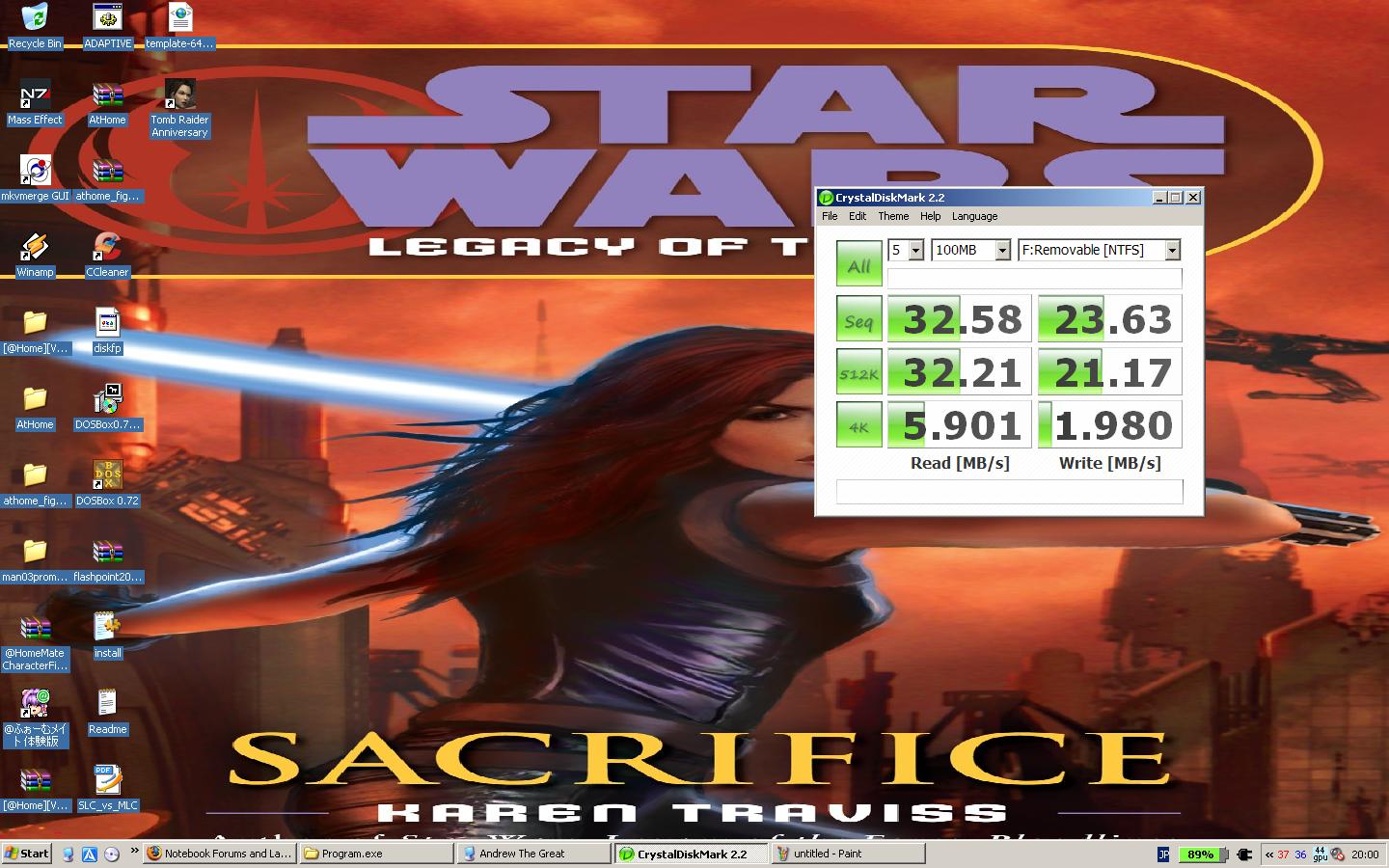
Here's the crystal mark score for my express card 64 GB SSD. This SSD is a Wintec brand. It's rated read speed is about 30 MB/s. This is where I bought it from: http://www.newegg.com/Product/Product.aspx?Item=N82E16820161318
Attached Files:
-
-
Hi,
Just in case you havent seen it yet, and own an Intel X-18 or X-25 SSD, Intel has release a new firmware update that corrects the problem with many small writes...
http://www.pcper.com/article.php?aid=691&type=expert&pid=10
Has anyone tried this new firmware yet? -
yes, some in this thread allready show before/after screenshots mainly from crystalmark
-
Yes my bad, didn't get any hits when searching the topic...I'll read up on those before installing the firmware myself.
-
just install it. it looks like it works perfectly and solves the issue.
one thing i'm interested: does the firmware update delete the data on the disk? i guess so, but i haven't explicitely stated it on any post, or the pcper review. -
No it doesn't erase the data on the disk. It affects data on the drive as much as BIOS update does which is nothing.
-
dunno if that has been posted yet somewhere on the board, but i guess i should do it anyway:
it seems there is another player in the ssd-controller arena : Sandforce is the name of the company and what they promise sounds quite good:
prices for ssd´s could drop to 1/3 or 1/4 of the prices we have now. and on top of that sandforce is promising some decent numbers for read/write performance.
this is from their homepage:
theinquirer published this :
i do hope the company can keep these promises concerning the price-drop and the high performance of these controllers. -
what i like is the detailed numbers. anyone want to join an ssd company to build that stuff from their design kits?
-
What the eff?
SandForce is claiming to have developed a controller with synchronous IOPS...I previously wrote that they were being deceitful in listing "30K IOPS", but they specifically publish that their controller as having synchronous 30K IOPS:
http://www.sandforce.com/index.php?id=146&parentId=34
If true, this blows Intel out of the water...
Edit: the above is only for their enterprise disks. Their mobile (consumer) product has 5,000 4K read/write IOPS. This is better than the Intel for writes, but almost 1/3 of the Intel for reads.
http://www.sandforce.com/index.php?id=19 -
maybe those are the minimum iops and they can get much higher for reads? no clue..
anyways, can't wait for stuff from them coming out. -
You can order an eval unit from them... Choice of 64GB SLC or 128GB MLC.
http://www.sandforce.com/index.php?id=143&parentId=2
It's a pretty loaded enterprise design, with super-capacitor for emergency power backup. -
RAISE (Redundant Array of Independent Silicon Elements)
YAY FOR ACRONIMS!! I HAVE A RAISE-DRIVE IN MY PC!!
oh, and, battery? sounds like they have onboard cache to power? that may explain partially the nice random write iops? -
Power Consumption: Typical: 3.2W
Maximum: 7.96W
thos power consumption is huge!!!! for sanforce SSD -
yes it would indeed. probably only writes data sequentially once it has a full block to do, so susceptible to power failure until that block is written. intel drive may even operate the same way just they dont publish it. certainly the way i imagined drives that do random->linear write remapping would work.
-
This is for this "preview/test" SSD, which has a serial interface and a lot of debug stuff on board.
-
What part of "enterprise-class" do you not understand... It's not a production design, and it's not intended for mobile/laptops. I don't see these guys being a major force in driving down the average cost of SSDs.
-
A little offtopic:
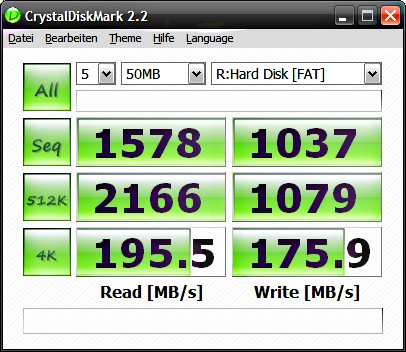
I just benched a ramdisk on one of my non-ssd computers. while the numbers are awesome and much higher than an ssd, the random read/write for 4kb are not that high. only a factor 10 or so for ssd's to catch up to be in similar playground. and it's not like ram has max-speed all the time, small random accesses have overhead, too..
still, i'd like an ssd with worstcase of 175MB/s
this is not really that actual or fast hw at all i'm testing here, i know. i'll test out on other configurations laters..
Attached Files:
-
-
^^^ Nice, Dave!
You play, TR, Anniversary ? Just kidding!
Thanks a lot. -
Daveperman, that's the thing though. DRAM is just like HDDs that even with low IOPS(comparatively) and random writes it has no particular weaknesses like flash memory does.
I don't think the Sandforce SSD has cache memory because that's what they say. And for the power consumption figures its really the controller only so its not that low either... -
Indilinx's Barefoot, doesn't have cache inside either. The cache (a 64MB DRAM chip) is outside the controller.
See photo @ http://www.anandtech.com/storage/showdoc.aspx?i=3535&p=1 (elpida chip) -
I was actually talking about the DRAM cache, but I guess I misunderstood everything in the first place lol.
-
Newegg has the 30GB Vertex for $119 with free shipping using promo code EMCLRMT45.
-
I couldn't pass up the 4.99 price on Steam that weekend. Filemate does sell faster Express SSD's but not in the 64 GB size. -
Darn... I was really hoping they'd get it back under $100. I shoulda picked up two back when they had the, what was it? $89.99 promo?
-
Eh, it could just have been a particularly inefficient RAMdisk implementation. But obviously if you're talking to RAM thru a SATA controller then the ATA protocol imposes a hard upper limit on command throughput and overall IOPS etc. If it was a pure software RAMdisk then the only limits should be CPU speed and memory speed (modulo quality of the software, of course).
As for Sandforce - it's obvious that the controller has a large cache embedded in the chip, otherwise they wouldn't talk about super-capacitors for backup power in their reference SSD design. It's also obvious that the *only* way to get consistently high performance with MLC is by using enough RAM to collect writes into page-sized chunks. And it's also obvious that this means it's possible for "committed" writes to be lost - if the flash array has a hard error, it won't be detected until a long time after the original write requests completed.
I'm guessing that they're doing mirroring (RAID1) internally, to minimize that risk. MLC data density is inherently 4x the density of SLC, but their reference MLC drive only has 2x the capacity of their SLC drive. Probably they sacrificed half the capacity by using it redundantly.
An erase block on a single chip is typically 128KB, and a single chip can sustain 30-40MB/sec read speeds.So to design an SSD that delivers consistent 250MB/sec read speed you need 8 chips in parallel. That makes your SSD erase block size 1MB. The page size is typically 2KB per chip, so that makes the SSD page size 16KB. So you need at least 16KB of cache to ensure efficient operation when receiving smaller write requests from the host. (Note that the JMicron controllers only have 16KB of cache...) Obviously this is a lower bound and is only sufficient if you're receiving a small number of small writes. If all of your writes are in multiples of 16KB then you can handle them directly with no cache munging required... -
MLC currently is only 2x the density (but 4x as cheap or something?).
there was 4x MLC anounced some weeks ago somewhere. but that was manufacturing tests only. -
I just pulled the trigger on a 64gb Vertex. Should be here Monday!
-
i wish you the best
have fun with it
(and report every dirty detail!!
)
-
LOL look at what this guy says... he had a "formula" in his signature and has since removed it when i questioned it
-
Thanks, Dave! I was reluctant to go OCZ, but the Vertex looks great, and OCZ and Indilinx really look to be out for blood, staying on top of firmware updates, etc.
-
Wasn't that sandisk?
-
Won't more bits per cell exponentially increase capacity, but also exponentially increase latency? 1 bit (SLC) offers 2 possible cell configurations, 2 bit (all MLC up to now) doubles that to 4, 3 bits doubles that to 8, 4 to 16, and so on. At 4 bits per cell that's 8x the capacity of current SLC drives, and 4x the capacity of current MLC drives...meaning SSDs will quickly surpass HDD storage density. Am I doing that right? No idea how it will affect latency, other than adversely, but hopefully newer controllers will be able to deal with that.
-
Will it affect latency or just write speed and wear leveling?
-
It is a good analysis, but it is based on assumptions. Where do you read in their specs that MLC and SLC drives will have the same write that is 256K ? From What I have read, the write speed will be up to 256KB/s and this I expect to be with SLCs.
-
only random write speed and wear leveling yep. (and the cells will have less write cycles till death, i'd guess).
but now that they got quite good at wear leveling and random writes in the latest generation, it may even be good enough for "slow" but nonstuttering mlc 4x drives.
would allow for big storage-ssd's. and slow is relative anyways, as they would still be as fast for sequencial writes (and that's where speed matters for storage-ssd's at least).
silent home-server, here we come
-
What do you use your RAMdisk for, Dave? Oh and sorry i never replied to your long response on the partitioning-guide. I have been busy and frankly discouraged after rereading the guide to find out 98% of it applied to spinners exclusively.
-
SSDs already surpass HDDs in terms of capacity per size. There is the Samsung 256GB 1.8", Super Talent 512GB 2.5", etc.
-
Geeks.com now has the Samsung 64gb mlc with the 90/70 read/writes for 134.99. http://www.geeks.com/details.asp?invtid=MMCRE64G5MPP&cat=HDD
Quite a bit cheaper than the PNY that newegg has. -
I know, I already pointed that out earlier myself, I was just more curious about the effects to latency and wear leveling. But yeah, if we get 4 bit/cell SSDs THAT WORK, that's a pretty hefty hammerblow to HDDs, as SSDs would then clobber them not only in terms of performance, but capacity as well. If it weren't for the cost...
-
When they say "bits" per cell, they literally mean how much each cell can represent. That means SLC, which is 1 bit can store 1 bit of data per cell, and MLC that's 2 bit can store 2 bits of data per cell, and 4 bit is 4 bits of data per cell so that's merely 4x as much not 8x or 16x.
The new SSD Thread (Benchmarks, Brands, News and Advice)
Discussion in 'Hardware Components and Aftermarket Upgrades' started by Les, Jan 14, 2008.