Problems? See this thread at archive.org.
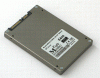
Just received this picture of the new 64Gb GT from Memoright which they say they will be shipping me out one to check out shortly...
-
Attached Files:
-
-
hm.. new samsungs right around the corner, intels around the corner, memorights around the corner.. sounds very nice.. except still no useful 64gb zif around
 (and i'd guess there never will..)
-
I don't know, "right around the corner" can be a very long time frame sometimes.
Cheers, -
i know. still waiting for a useful 1.8" zif ssd from mtron, announced since february.. grrrr
-
Engadget reported the initial prices for Intel SSDs. Looks like it's going to be a bit expensive than what I thought it would be. http://www.engadget.com/2008/08/19/intel-announces-its-first-ssds-plans-to-ship-in-a-month/
-
With the OCZ offerings at a little more than $4 / GB (MLC), Intel's offerings are quite a bit pricier at around $8/GB.
I'm old enough to remember when we were talking about Dollars per Megabyte, then Dollars per GB and now fractional dollars per GB.
Here's to more competition, which will hopefully help lower the pricing rapidly. -
that is pricy, I hope that will be the price for SLC, we're already around $10/GB for SLC.
-
I think that is for the MLC.
-
Micron is set to throw in their low cost ssds to compete with intel, ocz, and others. its starting to look like a big match up.
http://www.electronista.com/articles/08/08/05/micron.realssd.256gb/ -
from the article, 8$/gb is for the slc. which is actually acceptable. not great, but a step in the right direction anyways.
what i really like is that they create biggerthan32gb but smaller than64gb disks. perfect for workstationstyle environments with vista.. i really like the 40gb
-
Hey Dave,
I just received my Mtron Pata3018-32gb; But am unable to get it to work at dma6 and only get sustained read/writes up to about 70mb/sec (not the advertised 100mb/sec). But it only runs at DMA 5 mode in my HP2510p; not udma6. Was a bit dissapointed!
But it really beats the standard 1.8" 100gb drive that would only reach 30mb/secs at 12ms. accesstimes 0.1-0.4ms for the mtron, so quite happy but it could have been better. -
sounds nice (while not awesome...
).
i'm currently thinking of waiting for the 2730p and then get an sata 1.8" ssd.
anyways, where have you ordered yours? my orders so far never got a result
-
at www.gigaserver.nl
Even though they don't list them on their website I payed 240 euro's for the 32gb mtron including v.a.t. -
Dave:
Are you reading the same article as I am?
The M drives are MLC at $8/GB. Not competitive with other options in the $/GB war so they'd better bring stellar performance to the table.
Cheers, -
hm no that's not the same article. mine read slc...
why do you actually WANT to have right? my version was better..
if thei're performing twice as good, 8$/GB is still competitive, but yes, it's not that fun.
hope the prices will be better.. -
I definitely like your version better; but I'm paid to be picky about the details
There are a couple of positives here... Those are likely targeted MSRP, which means street could be 20-25% lower. While that's still exacting a pricing premium, it isn't quite as dear as the 2:1 figure we're seeing so far.
Cheers, -
You know that 2x performance for 2x price doesn't work for bleeding edge devices, right?? For example, the fastest CPU vs. the 2nd fastest CPU.
http://www.anandtech.com/cpuchipsets/intel/showdoc.aspx?i=3376
"The mainstream SSDs use MLC NAND Flash and thus have slightly slower write speed (and much slower small file write speed), but halves the cost per GB and thus makes these things affordable."
Mainstream SSD: MLC X18-M and X25-M
Extreme SSD: SLC X25-E
So X25-E will cost $16/GB and X18-M and X25-M will cost $8/GB.
Will they be fast?? Yea they will be really fast.
BTW, what are the read and write latency of the SSD drives?? I heard that the write latency of the SSD drives are slow. -
Don't know where you heard that from, IntelUser. Latency for both are usually an order (or more) lower than hard drives. That is the strongest point of the SSD. You probably were thinking of MLC's low random writes speed?
-
A "slow" SSD has a read latency of sub 1-millisecond (.5 - .8 msec). A 15K mechanical spindle has a latency of 5 msec, a 10K drive around 8 msec and a 7200 RPM drive in the 12-15 msec range.
If you do the math, your latencies are anywhere from 1/10th (against a 15K drive) to 1/20th (or less) on an SSD.
This may or may not translate to better performance depending on the read/write characteristics. On small transfers, the SSD could be done before the mechanical drive even gets the data.
Cheers, -
I think he was referring to some of the first SSD drives to hit the market had relatively low write speeds (MB/sec) compared to their spindle hard drive counterparts.
-
Yeah but that's only the read latency. What about the write?
-
Since latency is rotational latency plus seek time, I don't grok why the latency will be radically different for reads or writes.
Throughput is another issue entirely. -
Not on a HDD, but on an SSD what are they?
-
it works on my statement.
if they (intel mcl) cost twice as much as the current best price (ocz mlc), but offer twice the performance, then it's all nice.
they have much lower latency, much higher readspeed. write speed is okay. so the only big question is, what's the intels random write latency. as the ocz mlc has 0.25seconds random write latency (!!) it's not hard to make an ssd that performs _MUCH_ faster in random writes.
so i guess it's very possible that the mlc from intel is worth the double price. -
The latency (time to get to an address) is going to be about the same in either case -- the throughput i.e. how fast the data can be written is what varies.
-
No, I know they are faster. But there are some more exact numbers other than "0.1ms". Now we can go into microsecond range to see how it is, rather than showing meaningless rounded numbers. The write latency of the SINGLE benchmark I could find on the net showed 4-5x higher write latency compared to read latency.
Also, OCZ Core series was benchmarked to have 250ms random write latency. Is there are thing called sequencial write latency?? How come I never see benchmarks of them? Can anyone link?
daveperman: they have much lower latency, much higher readspeed. write speed is okay. so the only big question is, what's the intels random write latency. as the ocz mlc has 0.25seconds random write latency (!!) it's not hard to make an ssd that performs _MUCH_ faster in random writes.
Ok I dont' know the random write latency but here are the quoted figures for the X18-M and X25-M Intel SSD.
Read latency: 85us
Write latency: 115us
PCMark Vantage score: 20,000
As far as I have been able to search, only the Gigabyte i-RAM reaches the 20,000 mark in PCMark Vantage. -
How is the number meaningless when it's at worst an order of magnitude better than a mechanical drive. Do you really need to know how much more than 10x faster it is?
You're the one who says they've been benchmarked at value X. Why is the impetus on us when you're making the claims.
This is .085 and .115 milliseconds. Neither of these are dramatically far from .1 milliseconds. Also, what's the margin for error in the measurements?
There's more benchmarks out there though. -
and you're the one saying you dont think writes are any different to reads. but dont worry, ill settle that for you - its a SSD, it uses NAND flash memory, before writing to flash memory you must erase the whole block. erasing takes time. when a SSD has a large write block, it needs to spend a lot of time erasing for such a small write .'. random writes suck on many drives due to having too large blocks and no firmware compensation for random write.
if they were smart/werent in a hurry, they would have combined wear levelling with random->sequential write remapping. in other words, if they had 1000 writes of 4kb files, rather than having to erase 1000x8MB seperate blocks and re-writing the whole block + 4kb changed data, they would remap that section of the file to a part of a new block which it shares with all the other 1000 4kb blocks, and updates the mapping of each file (e.g. 50kb of it is here, and the other 4kb is here). then they just need to write a single 4MB chunk into a single block, and are only hit with the erase time once. im sure its much more complicated in practice, but the theory is there.
and that, combined with having smaller write blocks to begin with, is probably why the upcoming intel ssds reportably can get 2000 write IOPS rather than the core's 4 write IOPS (1s/250ms = 4).
the only two reviews thus far of OCZ core that actually know what theyre doing and both to test the single performance heel of SSDs (particularly MLC ones), random write performance - have both come out with 250ms write latency:
http://www.alternativerecursion.info/?p=106
http://i4memory.com/f9/4x-32gb-ocz-ssd-core-2-5-sataii-solid-state-disks-tests-8944/ (everest benchmarks in first post - ie this one)
if anyone has a core ssd, id urge you to do the everest (or similar) random write benchmarks to see if its the drive, or some incompatiability (since ocz seem to have majorly rushed the drive to market) causing the slowness. ive yet to see anything that indicates the drives are any faster than the two 250ms write latency results. plenty of IO queue graphs and similar show that the write latency must be pretty high. -
K folks...agree to disagree....
This is a phenom thread...lets keep it as such. -
i hope they fix that (at least a bit) in the v2..
would then worth the higher price.
what's important currently is not anymore where the ssd excels, because any new ssd is awesome compared to a harddrive. problems are currently (random) write latency in mlc drives. so i'm very interested to see how they evolve.
i'm especially interested as, as a dj, i need realtime performance and trust in my drive. i can't have it look-up windows for a while because it has to wait till some data is written because it's slow on it. blocking the gui, one thing (as long as the midi-interface doesn't get blocked), acceptable in most situations (but not all!!!). blocking the audio interface, never acceptable.
simply said, no one is anymore interested in best cases, but in worst cases. one have to trust those drives to never gett in the way in certain situations.
an ocz core is a no go for me because of the slow writing. i don't even want to think about recording the live-set on the same notebook with an ozc-core. a steady stream of small data that has to be written. could be the death of the ocz (and the death of my live performance at that moment). -
heres a couple pages on the intel ssds out of idf - one and two
first one has the third screenshot showing intels claimed MLC drive random write performance - at 3500 iops at 4k - compared to the best i remember, the memoright gt's, who gets a bit under 400 iops at 4k ( here), though testing methodology might be different
wonder what performance we'll see from the micron drives
the title, "The new SSD thread" would seem to indicate the thread is about SSDs, not phenoms. -
if it's true, these mlc's will truly be next gen, and close to nobody needs the slc versions (except for the real high end).
i'll happily pay 2x the money for ssd's that may beat memorights
-
uhh, Les created the thread. I'm sure he meant phenom to be phenomenal.
-
So, in summation, what do we have to look forward to in the coming month or two regarding at least semi affordable SSD's? The Intel SSD's. A refresh by Samsung??? NEW Micron drives??? Core Series Version 2 by OCZ? I admit that originally I thought nothing less than a SLC would do for me. I am now thinking that these new high end MLC's would be just fine and dandy for me
Once the "wave" hits, and people other than types like ourselves begin to want these, the field of storage will have shifted dramatically never to return to the days of old. Personally, I am glad i waited this long but am getting really frustrated as there always seems to be something "over the ridge" that is worth waiting for. I know that there is always this situation with anything TECH, but it really seems to be compressed with SSD's as things are changing UBER fast. Dave -
Almost a year to the day since I started doing reviews with my brand new Sandisk 5000. Funny how far ssds have come and yet, how little they have progressed in that they have evolved so fast nobody has a foothold on what consumers need just yet.
-
The latency for a write, ie the time it takes to access the block to write, is a different task from writing the block.
While they are in the end a combined result it is important to distinguish between the two.
What you are describing throughout your post, is diminished throughput in both IOPS and actual bandwidth. -
personally, i see the 250gb core v2 as my next purchase. unless intel, micron, samsung etc, can muster up a drive that equals or surpasses my mbp's (on order) hdd (250gb), i'm not switching, i need as much ssd space as possible, without going over the 700$ limit. i know that the 250gb core v2 will be more expensive, but im hoping it will decrease after the sales fly out of there. so samsung, micron, intel, heck any of the ssd makers, if you're listening, drop the price, raise the capacity, and the speed, and keep it userfriendly, cause that's what will sell!!!
i should start an ssd company with that logo, or i'll trademark the logo, and sell it to the first company that gives me like 5 of the drives i'm looking for... hehehehehehe (evil laugh) excellent! -
Les:
Have you seen or heard anything on the Ridata disks? Pricing looks competitive with Supertalent and OCZ Core series. Specs are a bit better (150MB Read / 92 MB Write) but we both knows specs don't necessarily translate into real world performance.
Best, -
I'm waiting to see Mtron's 260/240 MB/s ones. Intel's SLC ones are supposed to be 240/170 and RiData will have 235/120!!
-
Anyone have any hard info on Micron's entries into this foray???
-
I'm skeptical of those numbers -- and who knows what the pricing will be?
Intel's are supposed to be quite pricey ($8/GB for MLC). If Intel is staying up there in pricing, there's little impetus for others to offer solutions that are dramatically cheaper.
Pricing is staying on the wrong side of the curve, which doesn't bode well for spurring adoption.
Cheers, -
Personally, I wouldn't believe any of the hype until its actually tested. We, for some time now, have heard these or similar claims yet no independent supporting reviews from anyone as of yet.
I won't mention but this time last year there was similar claims by another company, those of which never came to be... -
Hey, i have a question. A few weeks back, sandisk made the news by blaming vista not being optimized for SSD. They didn't mention any technical details of what exactly needs to be optimized. I heard somebody say it's because windows uses 512bytes sector size rather than 4096bytes. But from what i understand, the allocation unit size is user selectable upon format so that can't be it right? So if i bought a new SSD, all i have to do is plug it into my desktop and format it with 4096bytes size and then install windows withough reformating and it would perform substantially better???
-
not really, it was generally just a copout/trying to move the blame elsewhere, rather than truely being a fault with Vista. its true that OSes arent typically geared towards SSDs, but its nothing that isnt difficult to overcome in the SSD firmware.
there was minor issues with vista not correctly reading the write caching preference/ability for user to change it, but thats been fixed by MS.
people have found out some of the few performance issues remaining with SSD drives (particularly cheaper MLC ones without any controller smarts) and are trying to pass the blame. ocz core debacle and compatibility issues are nearly all the fault of the ocz drive but theyre too trying to blame the os or chipset or anything else the average user may believe.
the bottom line is theyre making a SATA (or IDE) drive to be used in place of a traditional drive, and thus its their responsibility to handle the correct protocols and extensions (ahci/ncq), and to also account for the historical design of a HDD and handle it appropriately.
they're doing what they can to make the drive as cheap as possible (large block sizes which affects write performance, and no firmware considerations for random write performance due to keeping R&D costs as low as possible) and from a business point of view it probably makes sense to do that...but eventually someone will come along that does it right (hopefully intel but we'll wait and see) and everyone else will either follow suit or exit from the race. -
no os is developed right now for SSD's. vista is espencially optimized for non-ssd drives (with superfetch and similar)
but as well with knowing that every small read and write has some delay, and ergo it doesn't have to be fast while doing it as it'll take long anyways)
vista does profit much less from an ssd in booting compared to xp, as it's somehow less dependent on the actual disk speed while booting. the bottleneck is somewhere else.
future os' / service packs, etc will more and more target for ssd's, and maybe in the future a slow ssd with, say, 30mb/s readwrite will still outperform an ordinary old hdd in general os usage, just because the disk drivers and the read/write behaviour got changed for ssd usage.
but anyone blaming others is just stupid, espencially while all other disk vendors have no problems
-
I started a separate thread, but it probably belongs here.
I have a new Lenovo x200 with the 64gb SSD. It is a Samsung SLC SSD.
When I did a clean install (downgrade) of XP, I see that my C drive is only 54gb or so, total size. I do not believe that there are any other partitions (none show up in "My Computer").
Is this the correct formatted size? I figured it should be ~59gb or so.
Any insight appreciated. Thx!
goph -
I see the same thing on my OCZ 64GB SSD (MLC). 54GB available instead of 59. The answer I got was that the missing cells are held in reserve for wear leveling. Not sure if this would also be the case with an SLC SSD.
-
I really am surprised--I expected there to be ~91% capacity, so I am disappointed that an extra 4gb aren't available. On a drive this size, that is a lot.
EDIT: Ok, I think I discovered the reason--I used the Lenovo downgrade disks to downgrade from Vista to XP. The Lenovo disks basically install XP as if it had been done at the factory, ThinkVantage partition and all. Thus, the missing gigs are the ThinkVantage recovery partition.
Question: since I have the Lenovo disks, is there any reason to keep the recovery partition? If not, then I could use a partition utility to remove it and increase the C: space. -
Sooooo...
I dont plan on reading this entire thread. My question is- I have about $300-400 to spend on a 64gb SSD. Should I buy now (if so, which one) or wait until better technology arises (specifically for what)?
Thanks
Grady -
definitely wait and see what the intel pricing is like (and perhaps micron and see whether their performance compares to intels). should be within a month we get pricing details (speculation is $8/GB, but unclear if thats MLC or SLC drives). the random write performance and compatibility issues with the ocz core drive mean it should be avoided.
remains to be seen how the soon to be release core v2 drives perform. that may be worth upgrading to, but if core drives were any indication i wouldnt be holding my breath for huge improvements.
The new SSD Thread (Benchmarks, Brands, News and Advice)
Discussion in 'Hardware Components and Aftermarket Upgrades' started by Les, Jan 14, 2008.