Problems? See this thread at archive.org.
What did you get? Thanks for sharing.
-
This is the PB50EF (RTX 2070M) heatsink?
-
I got 8800~ on ffxv benchmark.
-
Hi Prema,
i am the proud owner of a Clevo P870TM-G (P870TM_TM1) Dual GTX 1070's in SLI and a multitude of other nice choices.
I've been scouring the forums looking for a BIOS, one of yours actually *surprise surprise* So from my understanding, only re-sellers can have these now. That's fine. But I've spent a good few days searching and emailing affiliate sites etc and not one is willing to remote flash my new laptop or whatever, i'd even pay for it. No one is interested.
This is the 3rd Clevo I've owned the last 2 had and still have your BIOS installed, i would love to have my latest and most powerful rig sorted as well.
Can you point me in some kind of direction (an online store or anything?) to get this rig setup with one of your BIOS's?
It's a little annoying that these BIOS's were one of the greatest things to come from the internet over the many years you have been doing this, but it's like the flow on effect of people having the good enjoyment of using your BIOS's has stopped, i bought my pc from METABOX.COM.AU and no joy with even them...
Thankyou mate, any help in a proper direction would be great, even though it appears i'm a newbie... I've used and read these forums for many many years. Usually i find an answer, and don't have to actually post....
- AushopperLast edited: Feb 14, 2019 -
Metabox is a Prema Partner and will hook you up if you bought the system from them:
https://premamod.com/partner/
The Partner program doesn't permit distribution without the respective hardware.Last edited: Feb 14, 2019 -
That is cool but I forgot which 2070 model bought.

-
Thankyou for your reply!
I'll reach out to Metabox again, this time bypassing sales who didn't seem to know what I was talking about. I'll give support a shot.
I'll post back here at a later date with the outcome.
Cheers!
- Aushopper -
Any news on the PB51s release? Are they out already? HID says in stock, but their product page still looks like a placeholder.
TomoPrime likes this. -
Sounds like a good plan, they should have the files.
-
Summarising the various opinions I read here, and looking at the resellers who allow preordering it, I think it won't be available before March.
-
Well, that makes sense, considering that even https://www.clevo.com.tw/clevo_prodetail.asp?id=1047&lang=en does not list PBXX series yet. I wonder if they would support 9th gen. CannonLake cpus with 8 cores out of the box.
-
Yeah, I was arguing the same thing some posts ago. I'm also interested in the PBXX series, but at this point I think I'll just wait for 9th gen CPUsjellygood likes this.
-
Apparently the 2060 version is available in China already. There's some customer images on the Hasee product page. Hope you got Google Translate because I can't link directly to the reviews tab...
https://detail.tmall.com/item.htm?s...2791878&scene=taobao_shop&skuId=3987851353023
EDIT: That's strange, now it's not letting me see them anymore.
EDIT 2: Dug them out of my cache

 Last edited: Feb 20, 2019
 -
That fan grille is strange. First time I see one like that.
Whatever, I will wait for the 9th gen Core version for sure now. The announced 8C/8T i7s look like very promising CPUs. -
Those things are going to run hot and throttle like crazy. Look at the 9900K. I mean, don't get me wrong, it will be an improvement, but I would hardly consider it "promising". True progress will be when 10nm arrives.
-
That's not entirely true - first of all, we're still talking about 45W processors, which thick notebooks like the PB5/7 should be comfortably able to cool. Second, current processors are made using an highly refined 14nm process - 14nm++ - and it's actually the fifth generation of CPUs made on this technology. 10nm processors, on the other hand, are late because they didn't meet the expectations, and we may have to wait for the 10nm++ step to get the a better performance/watt ratio than we what have now on the 5th gen 14nm++ process.
There was an Intel slide deck covering this issue exactly - you could see that they predicted the first generations of 10nm processors having slightly lower performance than the final 14nm process. There was also an Anandtech article explaining the how the transition will work:
So yeah, as far as we know now, it's not written on stone that the the upcoming 10nm/10nm+ processors will have better performance/watt ratio than current 14nm++ ones. In a couple of years they'll most likely be much better, but if I had to change my computer in the next months (which I'll probably do), I wouldn't wait for 10nm CPUs. -
The thing is Intel abandoned the 45W TDP limit starting with the 8th Gen series. All of their H/HK are the same silicon as desktop processors, but with it, their clock rates reduced to keep the voltages low . You want to turbo boost that 8950HK processor? Watch it hit 120W.
If you take an 8950HK and run it at full load (Prime95+Linkpack) and force it at the 45W TDP limit, it usually runs very close to its base clock. Fortunately, most laptops are designed to handle 55-60W TDP.
The speeds and performance numbers advertised by Intel for their laptop processors are mostly only attainable for short periods and if the laptop is designed to handle a 65-70W TDP processor.
Intel has always "refined" their production process once a year, for many years now, we know that every time they refined it they usually gain 10% extra speed. Their latest 14nm++ is no different. -
I strongly agree with this. My i7 6920hq has a tdp limit of 45w but watch it hit 75w on load! In prime95 it nears 80w but then again it performed close to a 4790k/6700k.
What intel shows as tdp is ********, the tdp is almost never that low even on load I see chips pulling more than advertised. I have a 8700t Es chip which is MEANT to only consume 35w on load. In my clevo it’s consuming 70w casually... it doesn’t overheat or throttle like a 8700k or 7700k etc. But come on the tdp is not 35w. -
This is true, still you answered only to the first line of my post however, I understand what you say: that's why I'm aiming at a laptop with a decently cooled chassis.
-
The new Aorus has a similar grill design as well I believe.
-
The TDP is for full load at base clocks usually.raz8020 likes this.
-
The gap between base clock (TDP) consumption and performance when uncapped will be even greater with an 8 core
If the i9-9980HK is a 2.4ghz base as I suspect (and 9880H 2.3), if their all core turbo is up near 4GHz they will need >100W to not power throttle even under turbo. The difference between what the same CPU can actually perform at in a monster GT75 vs a throttling mess Macbook Pro will be even bigger than 8th gen
The i9-8950hk was a $578usd tray price cpu, can't wait to see the 8 core HK price. Anything that makes owning a desktop-in-laptop P870 seem less insane by comparison is welcome
-
It's a pity that Hyper threading is only available on the i9 for the 9th gen.
Edit: Well the i5 has it but with 4 cores on 8 threads. -
Where'd that bit of info come from?
-
shouldnt be a surprise, would be unusual if they changed the laptop lineup to differ from the desktop naming convention (i9 with HT, i7 8c without HT, i5 6c or 4c with HT)
Sent from my Xiaomi Mi Max 2 (Oxygen) using Tapatalk -
8th gen unlocked BGA is bad value and coming i9-9980HK won't be any better. On top you pay an high price for performance you can't get (often +$600).
![[IMG]](images/storyImages/csm_corei965_b252995b39.png)
Our Core i9 verdict: It’s just not worth it on laptops
With almost a dozen Core i9-8950HK laptops under our belt, we have a pretty good idea about how these unlocked CPUs can perform. Average CPU performance is just 8 to 9 percent faster than the average Core i7-8750H laptop for a disappointing first year...
Users who really want Core i9 on a laptop ought to consider Clevo or Eurocom models as these systems carry standard LGA1151 sockets specifically designed to run desktop CPUs at comparatively higher TDP ceilings.
-
https://www.anandtech.com/show/13969/intel-details-new-9th-gen-cpus-for-notebooks-9980hk-9300h
There was a trending topic on Anantech.bennyg likes this. -
OK Thx.
I don't think they're right.
On the leak PDF, i7-8850H is a 45W, 6 thread 12 core part with a "CTP" of 386,987.
I chucked stuff into an excel spreadsheet, Regressing from known parts gives all the 8-cores a fudge factor of 24,500 per base clock GHz per core. i.e. 9900K and 9700K: 8 * 3.6 * 24500 = 705600.
The fudge factor for 6-cores is different, it's about 24805.55. e.g. 8700K: 6 cores * 3.7Ghz * 24805.55 ~= 550,683. (Quad cores it's approx 25416.7 and X series are different again, I also didn't bother looking at pre-skylake)
Regressing backwards on unknown parts on most of the assumptions (e.g. i9-9980HK & i9-9880H are 8-cores) gives round numbers on base clocks as all Intel parts have had. That's what makes me think the 9980HK has a 2.4 base and the 9880H a 2.3 base clock.
The i7-8850H is 2.6Ghz base, 6 * 2.6 * 24805.6 ~= 386,967: exactly the same score given to the i7-9750H AND i7-9850H which makes me think they will ALSO have a 2.6 base clock and 6 cores/12 threads (because no HT makes no sense), and will only differ by having slightly higher turbo.
Using the 8-core fudge factor on 386,967 gives an estimated base clock of 1.97 which is not a round number. -
Actually, looking at the CTP / MTOPS column, to me the new laptop CPU's look like 8 core / 8 thread sku's - no HT on the new laptop CPU's - that would explain the scaling of the CTP / MTOPS results in this table:
I think the 8c/16t listings are incorrect and these are CPU's without HT, and therefore only 8c/8t CPU's.Last edited: Feb 23, 2019 -
Hyperthreading on or off has no effect on the CTP metric only physical cores
NB:
9700K(F) 3.6ghz base 8 core 8 thread 705600, 9900K(F) 3.6ghz base 8 core 16 thread 705600
9600K 3.7ghz 6 core 6 thread 550683, 8700K 3.7ghz base 6 core 12 thread 550683 -
Yeah, laptop CPU's, I meant the new 9980HK and 9880H laptop CPU's.
The 9900k / 9700k desktop CPU's would now be "old" CPU's.
And, we already know the sucky HT treatment for the "old" desktop CPU's, with only the 9900k having HT 8c/16t.
It's a big drop in performance this time for the laptop CPU's, seems there is more to the story than 8c/16t vs 8c/8t, clock and power limits most likely.
Maybe Intel is tired of laptop makers not providing enough cooling and are performance throttling the laptop versions this time, like Nvidia is gimping the laptop 20 series GPU's.Last edited: Feb 23, 2019Papusan likes this. -
There is only so far you can go within each power band, you can't cheat physics.
-
Indeed, Intel specifies TDP as follows:
" Thermal Design Power (TDP) represents the average power, in watts, the processor dissipates when operating at Base Frequency with all cores active under an Intel-defined, high-complexity workload."
Also according to Intel:
i9-8950hk is 6c/12t cpu with base clock of 2.9 GHz and TDP of 45W
i7-8750h is 6c/12t cpu with base clock of 2.2 GHz and TDP of 45W
Sorry for the ignorance, but i just don't understand how both 6 cores all running @2.2ghz and 6 cores all running @2.9 ghz can dissipate the same amount of heat power if tdp info about both cpus provided by intel is correct.
What am i missing ?Last edited: Feb 23, 2019hmscott likes this. -
-
Intel's "TDP" ratings are at base clocks only, nice, right?
It's a mystery how Intel continue to pull this deception off and get away with it. -
Could you please be more precise about this ?
In what i was wrong ?
Did i reported wrong specs ?
And what do you mean by " binning" ?
Sorry if this is very simple to most of you but i'm just newbie on this stuff. -
TDP is a recommendation of cooler and is equal to the CPU's power limit or PL1. It doesn't take into account the higher turbo boost PL2 power limit which is +25% (but configurable by motherboard or laptop maker) intended to be set for a limited time. That wasn't such an issue when turbo was like an extra 5% on single core like it usually was (e.g. 6700K, an extra 200mhz on 1 active core only), the CPU never used anywhere near its PL2. Then Intel changed it up with the 8th gen and got way more aggressive with turbo, and the all core turbo was now set to this higher PL2 power limit, and 8700Ks came along which used that extra power on desktop motherboards, some with removed limits and timers. So half the tech press were benching this "95W" CPU using 130W and the other half were stung by the MCE-on-by-default fiasco and benching them at 4.7ghz and ~160W under long term 100% load. So suddenly a lot of people woke up and said "umm Intel you call this a 95W CPU WTF?"
So if you had chosen, according to the "95W TDP", a "95W cooler" specified and tested in a lab to dissipate 95W without hitting 100C, suddenly you have a "95W CPU" out of the box drawing way over 95W, and overheating like crazy.
As to binning - not all of the billions of the transistors and traces in a CPU are fabbed perfectly. Some bits of it are broken and have to be completely disabled. Some bits will be "leaky", that is, still work, but need or leak more power than intended. It's this combination of defects, stability, leakiness, and required voltage that determines whether an individual die is sold as a i3 with some cores, cache and hyperthreading disabled, or all the way up to a top end i7 or i9 with overclocking headroom to spare, since making different dies is expensive it's cheaper overall to rely on dodgy parts filling out the lower tier options rather than fab different dies for each CPU designation. So for example, when an individual six core Coffee Lake-H die is tested, assuming all its cores work, if it uses 45W at between 2.2 and 2.6ghz it's a i7-8750h, if it uses 45W between 2.6 and 2.9 it's a 8850h, if 2.9 or greater its an i9-8950HK. Within each SKU, there is a spread of "good" and "bad" chips - whether an individual laptop's 8750H uses its 45W at only 2.2ghz, or can actually do it at 2.59ghz, is the "silicon lottery" -
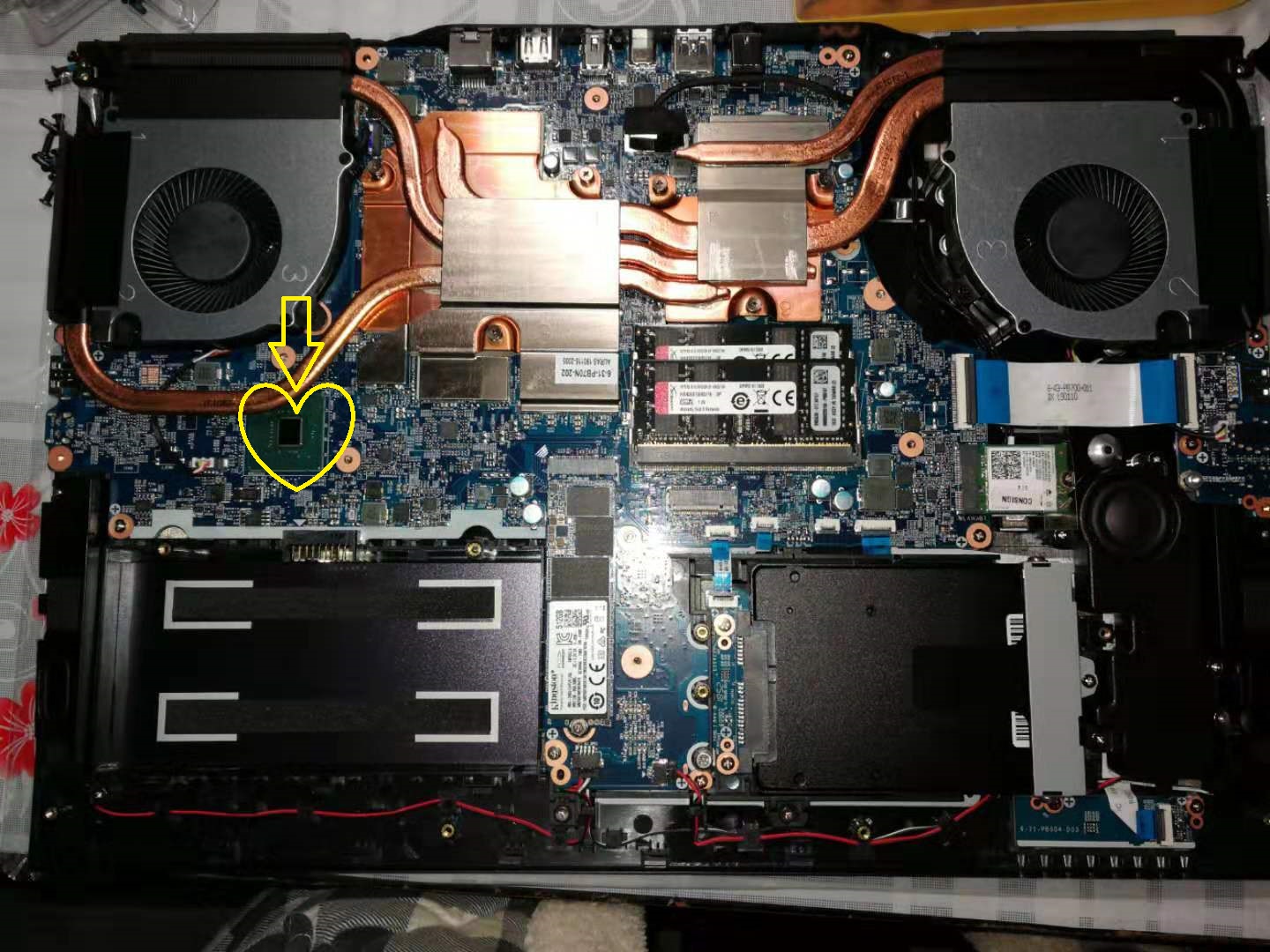
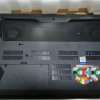
Internals of Hasee's PB70ED
All PB models have under-keyboard screws holding the bottom cover.Lamim Rashid, yrekabakery, raz8020 and 1 other person like this. -
What is this?
Attached Files:
-
-
That's the PCH (ie "Chipset"). It contains the SATA, USB controllers and all that ancillary stuff.
Most desktop boards cover it with a big flashy heatsink on the bottom right.cj_miranda23 likes this. -
-
So on the topic of 8750h vs 8950h why don't people just overclock their 8750h slightly, along with a slight undervolt? Correct me if Im wrong but it seems to me that if you want sustainable thermals, power draw, and turbo clock you have to underclock and undervolt the i9 laptop CPUs anyways.
-
-
Ah, that makes sense. Are the higher clocks on the 8950 even sustainable on laptops less than 3cm thick?
-
locked even for UV?
Sent from my Xiaomi Mi Max 2 (Oxygen) using Tapatalk -
-
dont really care either way tbh LOL just making small talk here hahaha
Ashtrix, j95, Mapl and 1 other person like this.
-
Depends on the machine and the chip. In a way it's a bit like the 4th gen extreme series. You clocked it up a bit and undervolted at the same time to get something faster and more consistent.
Clevo 2019
Discussion in 'Sager and Clevo' started by steberg, Jan 6, 2019.